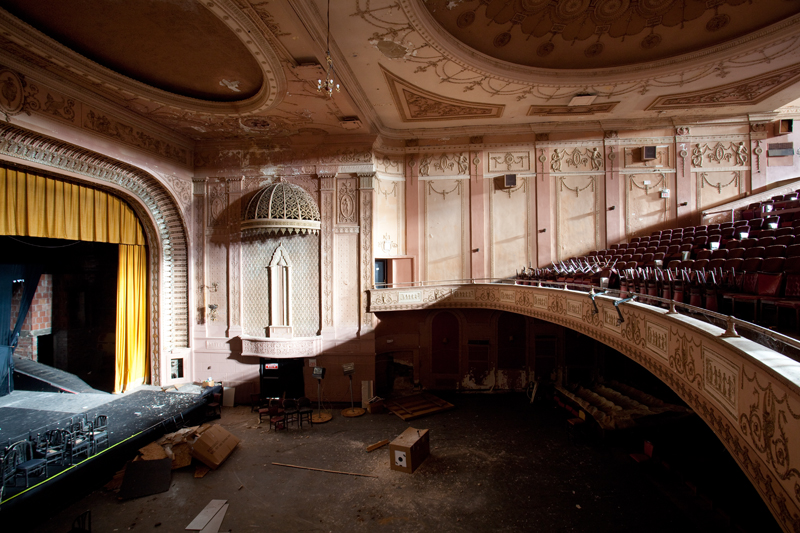
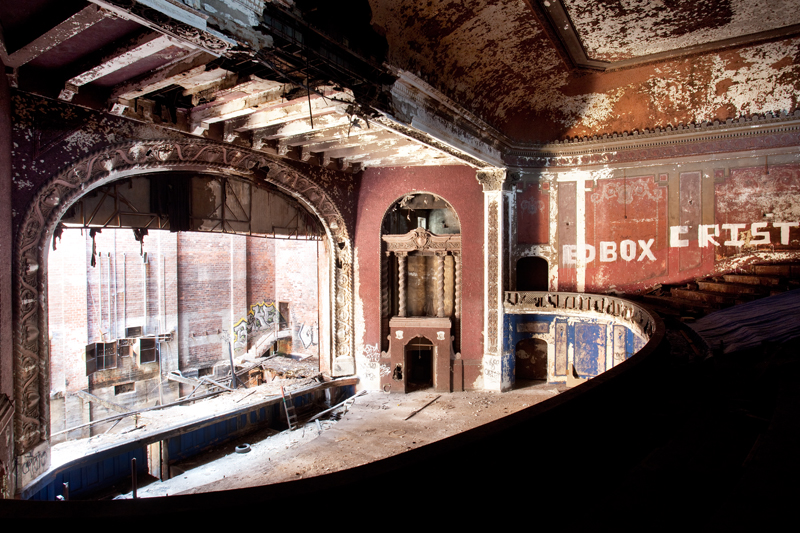
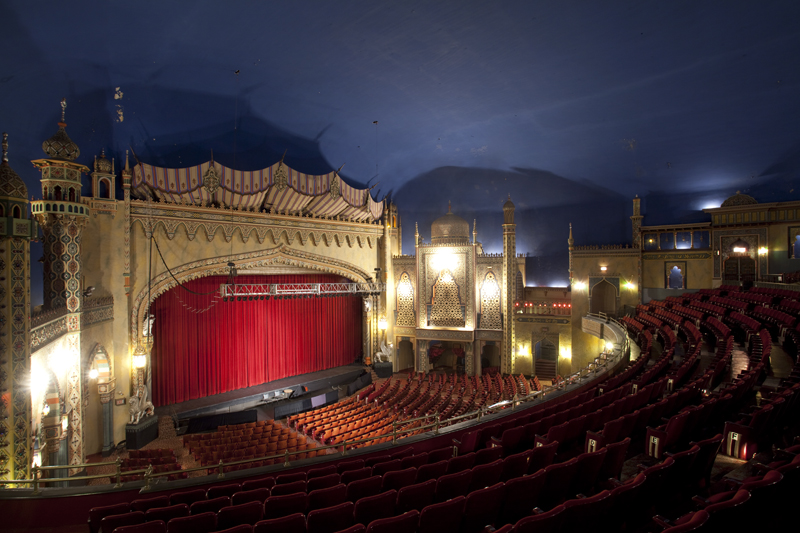
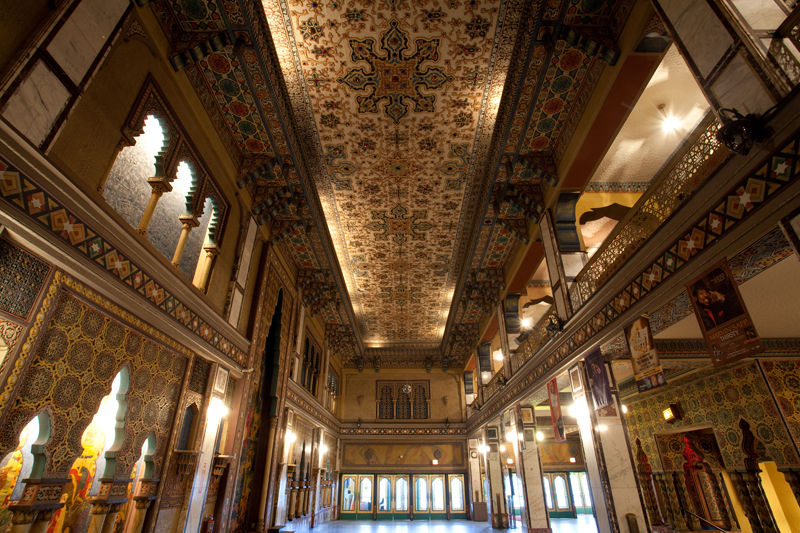
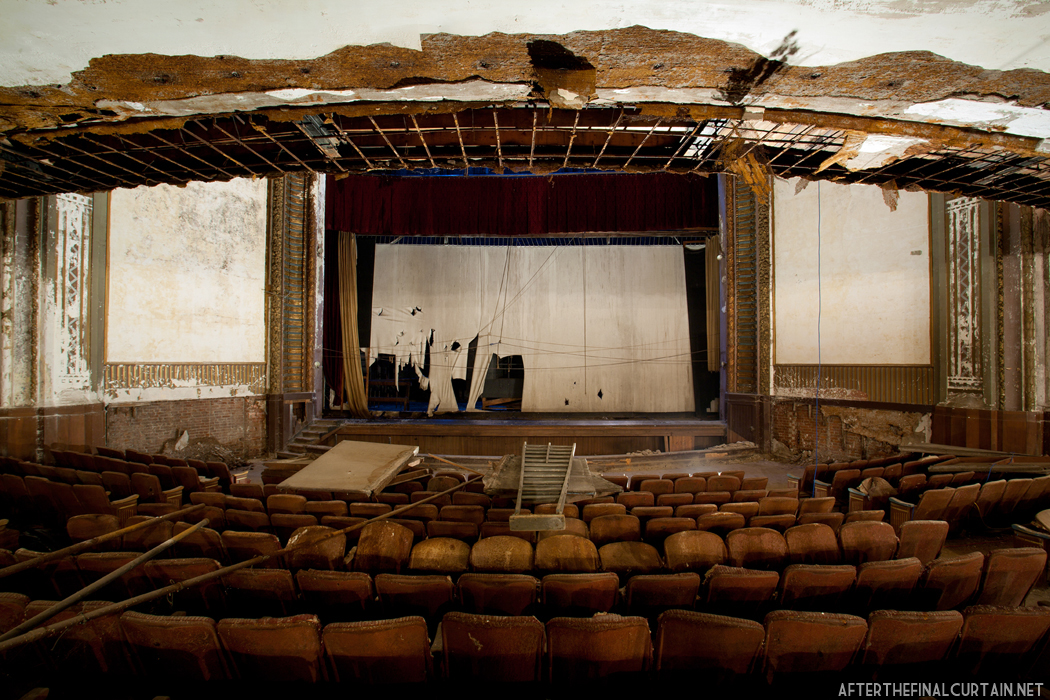
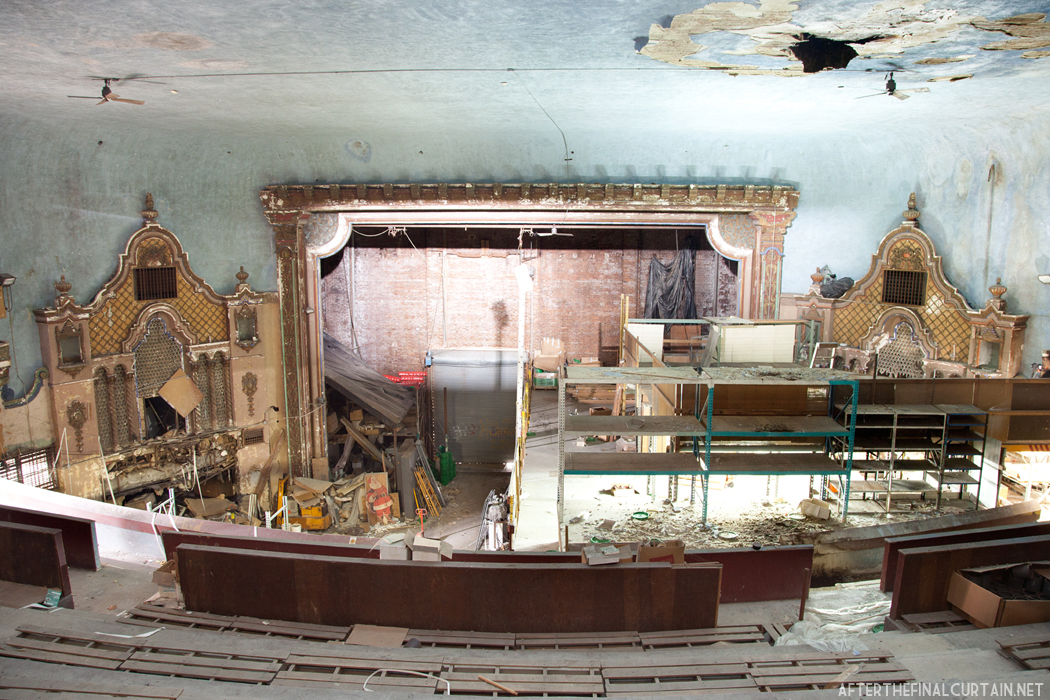
I spent most of my second day in Chicago photographing the New Regal Theatre. This John Eberson designed theater opened in 1927 as the Avalon Theatre. It is said to be inspired by a Persian lamp Eberson found at an antiques market. The Regal closed in 2010 .
Road Trip Day 1
Loew’s 46th Street Theatre
The Loew’s 46th Street Theatre opened on October 9, 1927 as the Universal Theatre. It was designed by John Eberson, a famous theater architect known for his atmospheric style auditoriums. According to an account in the Brooklyn Eagle, 25,000 people were present for the opening of the theater. The 2,675 seat theater was acquired by the Loew’s Corporation in August 1928, and closed so renovations could be made to the sound equipment. It reopened on September 10, 1928 as the Loew’s 46th Street Theatre.
Q&A with Kathy McKean, Managing Director of MIFA Victory Theatre
I recently spoke with Kathy McKean – the Managing Director of the Massachusetts International Festival of the Arts. MIFA owns and is renovating the Victory Theatre in Holyoke, MA.
1. What is MIFA?
“MIFA is a Holyoke based International Festival that brings world-class events to Holyoke and the Pioneer Valley. MIFA’s 2011 Season included Hal Holbrook in ‘Mark Twain Tonight’ and Silent Film Night The Last Command. Other presentations in Holyoke have been Shakespeare’s Globe Theatre in ‘Love’s Labour’s Lost’, contemporary Irish Dance in ‘Irish Cream’, Eddie Palmieri in Concert, a series of French Dance, Enchanted Circle Theatre in ‘Sojourners Truth’ and Mikhail Baryshnikov 2004 World Tour. MIFA is a vehicle for community restoration and historic and architectural preservation and is renovating and reopening the historic Victory Theatre, a 1600 hundred-seat Broadway style theater in downtown Holyoke. The iconic theater will be returned to its original use as a live theater house for Holyoke, the Valley and the Northeast.”
Victory Theatre
The Victory Theatre opened on December 31, 1920 in Holyoke, Massachusetts. The 1,680 seat theater was built by Mowll & Rand, an architecture firm based out of Boston. The firm was also known for the design of the Calvin Theatre in Northampton, Massachusetts. The Victory was commissioned by the brothers Samuel and Nathan Goldstein of Western Massachusetts Theatres Incorporated.
Paramount (Broadway) Theatre
The Paramount Theatre opened as the Broadway Theatre in Long Branch, New Jersey on August 1, 1912. The project was commissioned by theater magnate Walter Reade on the site of an old Episcopal church. The 1,772 seat Broadway began showing plays and vaudeville performances before transitioning over to film.
The Charles (Bijou) Theatre
The Bijou Theatre (later the Charles Theatre) opened in the fall of 1926. Architect Eugene DeRosa was commissioned by the Delancey-Clinton Realty Company to build the Bijou at 12th Street and Avenue B in Manhattan’s Lower East Side. The theater had 600 seats, 502 on the main floor and 98 in the balcony.
The Ridgewood Theatre
The Ridgewood Theatre opened on December 23, 1916. Located in the Ridgewood neighborhood in Queens, New York, the 2,500 seat theater was built by the Levy Brothers Real Estate firm. The Ridgewood was designed by famed theater architect Thomas W. Lamb, who is known for the design of many New York area theaters. The Ridgewood was modeled after the now demolished Mark Strand Theatre, which was the first ever motion picture palace.
Q&A with Howard B. Haas, President of Friends of the Boyd
After photographing the Boyd Theater I learned a little bit about the Friends of the Boyd. I had a lot of questions, and luckily the group’s president and chairman Howard B. Haas was available to answer them. Below are his responses to several questions about the history of the Friends, his own personal experiences with the theater and some of his hopes for the future.